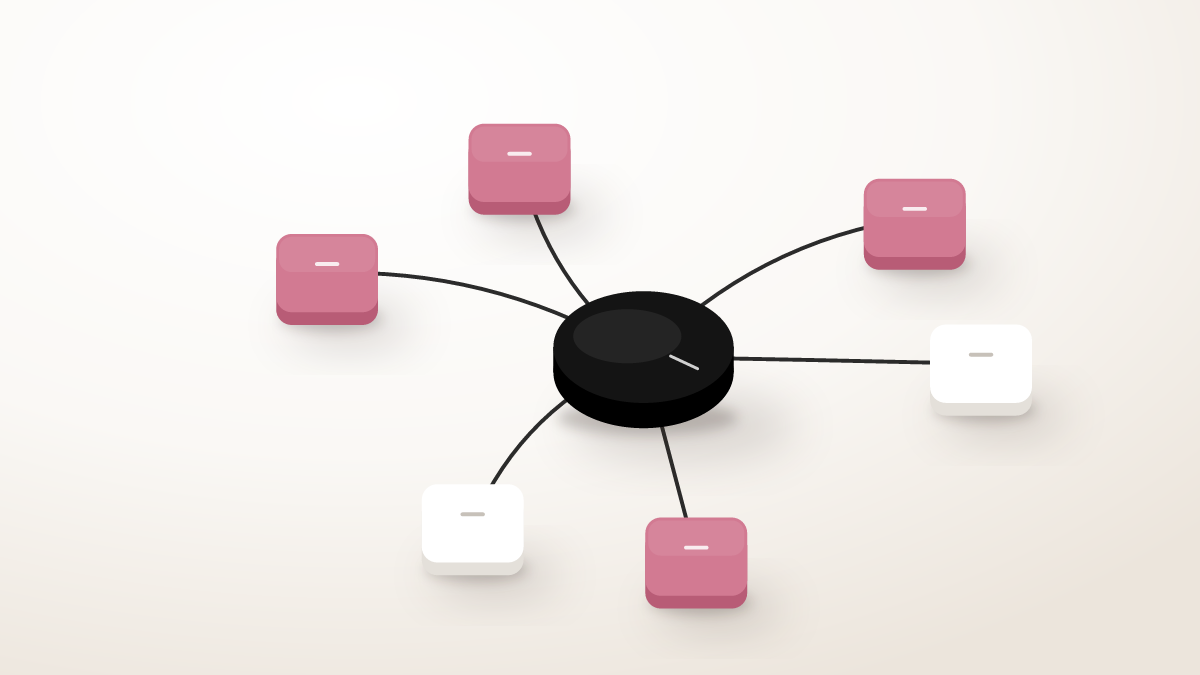
A GTM AI engineer is one operator who wears four hats. An engineer who ships code, an AI ops manager who tunes prompts, an agent orchestrator who designs workflows, and a copywriter trained on the company voice. In 2026, one person with these four disciplines runs work that used to need a small revenue operations team.
That is the whole claim. The argument worth reading is why the four hats fused into a single seat, where each hat actually shows up in a working week, how the role splits from RevOps, and what to pay for someone credible across all four rather than two.
What the GTM AI engineer role actually is
A GTM AI engineer turns the AI part of a revenue org from demo into production. They do not maintain the CRM. They do not write the press release. They build the data pipes, the agents that act on signals, the prompts that talk to buyers in the company voice, and the checks that prove the system still works on a bad day. That build is AI native GTM engineering in practice.
The case for the role is not theoretical. Clay's published account of Verkada says its GTM engineers automated around 80 percent of SDR workflows so reps book roughly 4x the meetings per month, landing at 80 to 100 per rep (Clay). That output does not come from one job title. It comes from one operator switching hats inside a single week, which is exactly what confuses hiring managers reading the job from the outside.
The non-obvious read is that the four hats are not a wish list of skills. They are four distinct failure modes. Miss the engineer hat and the workflow lives in a vendor UI you cannot fork. Miss the AI ops hat and the agent quietly drifts off voice. Miss the orchestrator hat and you ship a pile of disconnected scripts. Miss the copy hat and the buyer pattern-matches your outbound as spam. Hire someone strong on two hats and you have bought yourself the other two failures.
Hat 1, the engineer who reads code and ships it
The first hat is plain software engineering at a script level. Read APIs, write Python or TypeScript, commit changes, debug a broken webhook at 9pm, ship something that runs from a laptop or a cron job.
This is the hat most marketing operators lack, and it is the one that decides whether you own your pipeline or rent it. If a workflow only exists inside a closed canvas, you cannot fork it, you cannot read the diff, and you cannot roll back when an agent goes off voice. If the same workflow lives in a folder of scripts and markdown files you wrote, you can do all three before standup. That ownership test is the operator judgment a generalist will not commit to, because the generalist treats the workflow tool as the product.
A real day looks like reading API docs to add a firmographic filter, patching an agent that fell over when a site changed a selector, or writing a reconciler that catches duplicate leads before they reach your sender. None of this is heroic. It is the operator equivalent of changing a tire. The cleanest entry path is running Claude Code for sales workflows, where the terminal is the IDE, the prompt is the function call, and the markdown file is the version-controlled config. The build your own GTM agent tutorial walks that same runtime from a blank skill file to a scheduled lead qualifier — the exact output this hat ships.
Hat 2, the AI ops manager who tunes prompts and watches agents
The second hat is what many teams hire for and mistake for the whole job. AI ops keeps the agents honest. You write the system prompt, evaluate outputs against a small golden set, watch reply rates, and rewrite the prompt when the language drifts. You version every prompt with a timestamp so you can roll back to the one that worked last week.
This work has its own grammar. Prompts are not source code, but they behave like it. A temperature change ripples through a whole sequence. A new model release can move outputs noticeably overnight. The AI ops hat treats every prompt as a deployment, every output sample as a test, and every regression as a bug to file rather than a feature to redesign. The decision rule that separates this hat from casual prompting is simple. If you cannot name the exact prompt version that produced last month's best email, you are not running AI ops, you are gambling.
Without this hat, AI sales agents ship three off-voice messages in a week and the operator's only recourse is a support ticket. With it, the agent that wrote a strong email last month writes a strong email this month, because someone is watching both the inputs and the outputs.
Hat 3, the agent orchestrator who designs the workflow
The third hat is the architect. Given a goal, book 30 discovery calls a month from Series B SaaS companies that just hired a head of growth, the orchestrator designs the agent graph that gets there. Which signal fires the first action, which data source enriches what, which agent writes, which classifies the reply, which logs to the CRM, and which wakes the human because something needs a decision.
A few years ago this hat lived inside n8n, Make, Zapier, or Tray, and the graph of boxes and arrows was the deliverable. The medium has shifted. The angle incumbents skip is that orchestration is now better expressed as markdown-configured agents than as nodes on a canvas. A folder of 40 markdown files reads in an hour. A graph of 40 nodes does not. The folder is also reviewable, versionable, and recoverable like code, while the canvas is a screenshot.
The orchestrator litmus test is one line. If a vendor cannot show you the prompt that drives your outbound, you do not own the playbook. State should live somewhere you control, which is why many operators keep durable knowledge in Notion wired to agents through an MCP rather than in a Zap, then point the orchestration layer at it. The canvas matters less than the configuration medium underneath it.
Hat 4, the copywriter trained on your voice
The fourth hat is the one engineers do not see coming. Copy is half the job.
An agent writes a 200-word LinkedIn message in a second. The open question is whether it reads like your company or like a thousand others. Tuning for voice means feeding the agent your sample library, the founder's actual posts, the team's past replies, and a tight system prompt that names the specific tone moves to make. This hat builds that library, judges what is on voice, and rewrites the prompt when the output goes generic.
Sales tooling understood this in pieces. Lemlist ships AI agents inside its sequencer, priced at $87 per user per month on the Multichannel plan billed annually, or $109 month to month, with an email-only tier at $55 per user per month annually (Lemlist pricing, fetched June 2026). The plumbing is there. The voice in the message is still your problem, because a vendor cannot ship your founder's writing samples. That work stays with the operator, which is why voice is the hardest of the four hats to outsource. It belongs to the company, not the contractor.
How a GTM AI engineer is different from RevOps
RevOps and the GTM AI engineer role sit near each other on the org chart and diverge on the work. RevOps maintains the system of record. They own forecasting accuracy, territory cuts, comp plans, pipeline reviews, and CRM integrity. Their default question is whether the reporting tells the truth.
A GTM AI engineer builds new capability on top of that same system. They do not own forecasting. They own the signal pipeline that feeds the model that informs the forecast. They do not own the comp plan. They own the agent that drafts the note that books the meeting that drives the quota. Their default question is whether the workflow ships pipeline this week. Skaled frames it as RevOps maintains while AI GTM engineers upgrade (Skaled), and that holds.
| Dimension | RevOps | GTM AI engineer |
|---|---|---|
| Core mandate | Maintain the system of record | Build new capability on top of it |
| Default question | Does the reporting tell the truth | Did the workflow ship pipeline this week |
| Owns | Forecasting, comp, territories, CRM hygiene | Signal pipelines, agents, prompts, outbound runtime |
| Writes code | Rarely | Daily, at a script level |
| Tunes prompts | Rarely | Daily |
The practical line is that a RevOps person rarely codes and rarely tunes prompts. You can promote one into the role only if they pick up the engineer hat and the AI ops hat, which most do not want to.
Why these four disciplines collapsed into one role
Five years ago this work needed four people. A backend engineer for the scripts. An AI specialist for the prompts, a role that barely existed in 2022. A workflow ops person to wire the canvas. A copywriter for the messaging. Four headcount, four sets of context to keep aligned, and a standing integration tax between them.
Three forces flattened that team into one seat. Model quality crossed a threshold, so a strong prompt plus a frontier model writes copy a senior writer shipped two years ago. Tooling consolidated, so Claude Code, MCP servers, and markdown configuration replaced the three separate surfaces, the IDE, the prompt console, and the workflow canvas, that the four roles used to inhabit. And the work stopped paying enough to carry four full headcount, because the modern B2B lead generation stack compounds on signal and reuse, not on team size.
The reason the hats fused is not that AI is magic. The glue between four people doing four jobs costs more than one person who does all four well enough. Some teams hire that operator in. Others bring in a fractional version to stand up the four hats and graduate to a full-time hire, which is the path we run under the Yalc fractional GTM AI engineer offer, because most companies need the role for a quarter before they need it for a year. If you are weighing fractional GTM engineer services against an agency retainer, the trade on depth, ownership, and offboarding decides which model actually ships the four hats.
The skill stack to hire and interview for
Hiring is hard because the resumes do not match. Candidates come from software engineering, RevOps, and growth marketing, and the job descriptions oversell the list. The stack that actually matters is short.
The non-negotiables:
- Python or TypeScript at a script level. Not a senior engineer, but someone who reads a function and ships a fix.
- API fluency. Reading docs, authenticating, paginating, handling rate limits. This is where most marketing ops candidates fall down.
- Prompt design. Writing system prompts, evaluating outputs, versioning prompts in a repo.
- One sender stack run end to end. Email infrastructure or LinkedIn limits. Without it the agent ships into the void.
- Written taste sharp enough to spot off-voice output. If they cannot, no amount of prompt tuning fixes the copy.
Nice to have: SQL and a warehouse view, embeddings and basic retrieval, prior n8n or Tray experience.
The interview that works is to hand the candidate a real workflow you want shipped, two hours, and a sandbox. Watch what they open first. The ones who open Python, a markdown file, and a prompt in the same window are GTM AI engineer hires. The ones who open a workflow canvas are workflow ops hires, which is a real and different role. That single observation predicts the fit better than the resume does.
GTM AI engineer salary bands in 2026
Pay has moved fast and is still moving. Cleanlist's 2026 guide bands US base salaries from roughly $90K for junior up to the low $300Ks for staff and head-of roles, with staff total compensation reaching $500K once equity vests (Cleanlist). Remote-friendly companies tend to pay 80 to 90 percent of the metro numbers, and roles outside the US run lower again.
Two variables move the figure. The volume of pipeline the role is accountable for, and how many of the four hats the candidate genuinely wears. Someone strong on one or two hats gets paid like a senior marketer. Someone credible on all four gets paid like a senior engineer. The market is still pricing that gap, so the right hire is usually undervalued and the wrong hire overpaid. Fractional versions clear at a fraction of the full-time cost, which is why bootstrapped founders and operator agencies buy the work monthly rather than hire for it. Use the AI SDR tools map to decide which categories you actually need before committing to a headcount.
Run the four hats from one prompt
The hats collapse into one seat because the surface they work on collapses with them. The operating-system pattern runs all four from a single Claude Code conversation. The engineer hat reads and writes the markdown files. The AI ops hat tunes the prompts inside those files. The orchestrator hat designs the agent graph as folders of skills. The voice hat lives in the system prompt and the sample library checked into the same repo.
The boundary that makes one operator credible across four hats is the first-and-last-mile rule. Humans own the first mile, which is strategy, ICP, angle, and taste. Humans own the last mile, which is the call, the deal, and the relationship. The system owns the middle mile, which is data wrangling, sequence orchestration, signal capture, and agent runtime. The operator is not doing four jobs at once. They are deciding what runs in the middle mile and letting the system carry it.
To pressure-test the role this week, open the modern GTM stack and label each tool by the hat it serves. Send infrastructure is the engineer hat. The prompt vault is AI ops. The workflow canvas is the orchestrator. The copy library is voice. Most teams own a tool for one or two hats and nothing for the others. That gap is the role. If someone in-house already wears two hats well, you have a promotion path. If not, decide between hiring, which takes six to nine months to ramp, or renting an embedded operator for a quarter under the Yalc fractional GTM AI engineer offer. Buying another point tool that promises to be the AI SDR for you is the slowest path to the same place.
Frequently Asked Questions
What is a GTM AI engineer?
A GTM AI engineer is an operator who builds and runs the AI part of a revenue org. They wear four hats, software engineer, AI ops manager, agent orchestrator, and voice-trained copywriter. The role differs from RevOps because it ships new capability rather than maintaining the system of record.
How is a GTM AI engineer different from a RevOps person?
RevOps maintains the existing system, forecasting, comp, territories, pipeline review, and CRM hygiene. A GTM AI engineer builds new workflows on top of that system using AI, agents, and APIs. RevOps rarely codes or tunes prompts, while a GTM AI engineer does both daily, which is the practical line between the two roles.
What skills does a GTM AI engineer need?
The non-negotiable stack is scripting fluency in Python or TypeScript, API literacy, prompt design and evaluation, one end-to-end sender stack, and written taste sharp enough to judge whether an agent is on voice. SQL, embeddings, and workflow-tool experience are useful but not required. Most candidates fall down on API fluency rather than on the AI itself.
How much does a GTM AI engineer make in 2026?
US base salaries run from roughly $90K for junior hires to the low $300Ks for staff and head-of roles, with staff total compensation reaching about $500K once equity vests, per Cleanlist's 2026 guide. The market is still pricing the gap between candidates who wear all four hats and those who wear two, so strong hires are often undervalued.
Do you need to know how to code to be a GTM AI engineer?
Yes, at a scripting level. You do not need to ship production backends, but you do need to read API documentation, write a Python or TypeScript script, debug a broken webhook, and version-control your changes. Candidates who cannot do this end up as workflow ops hires, which is a separate role.