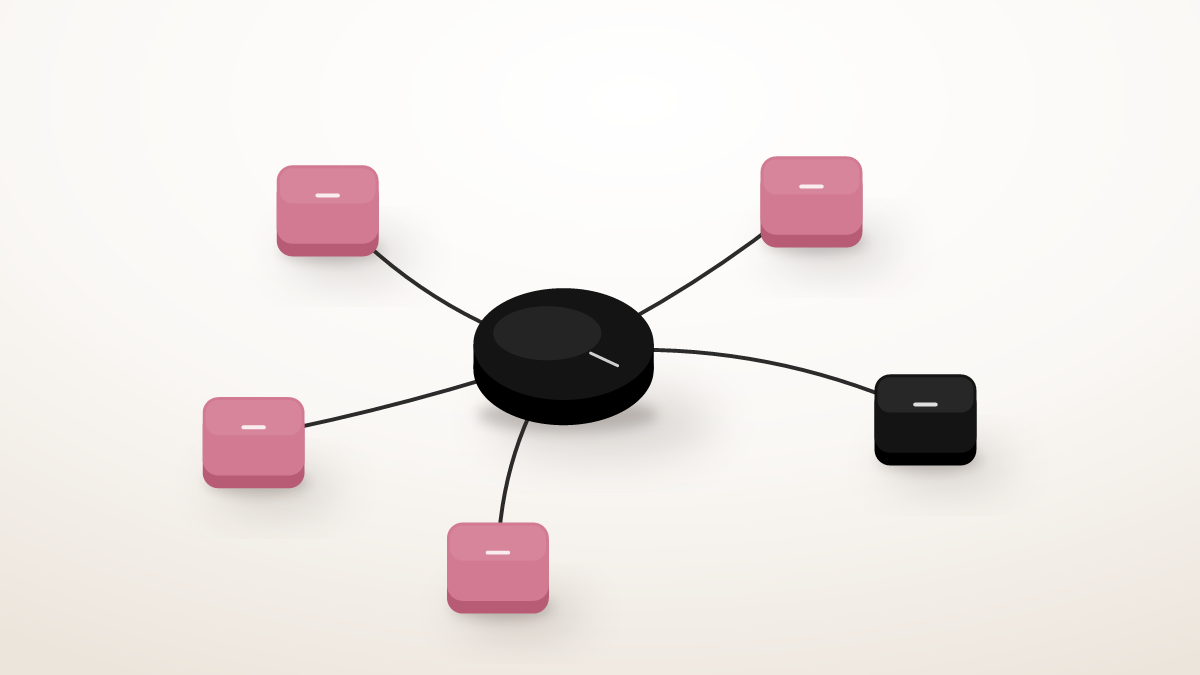
A GTM stack is the set of tools a revenue team uses to source accounts, enrich contact data, reach out at the right moment, and route qualified interest to a human. A modern GTM stack does that job at six tools, not twenty three. The average B2B team now buys software from 23 separate vendors while the best-performing teams run four to six core platforms. GTM engineering is the discipline that makes that possible: pick one tool per layer, then orchestrate all of them from one prompt instead of a workflow graph. Logo count is not the metric that compounds pipeline. The number of plays you can run cleanly at the same time is.
That gap between what teams buy and what they use is the real story of the GTM stack in 2026. Below is why every operator builds the bloated version first, where the integration glue eats the week, the six-tool minimum that holds, and a migration path that does not blow up live pipeline.
What a GTM stack covers
A functional GTM stack covers five jobs: find the right accounts, enrich contact data, reach out through the right channel, classify replies, and log activity back to the CRM. The sixth layer is orchestration — the piece that connects all five without a workflow graph. Most stacks fail not because the tools are bad but because there is no layer owning the handoff between them.
A good GTM stack is easy to test against three questions. Does each layer own exactly one job? Can the operator swap any layer without rebuilding the rest? Can a single prompt trigger a full play end to end? If all three answers are yes, the stack is worth keeping. If not, the bloat is already there, it just does not show up on the invoice yet.
GTM stack examples by layer
A 2026 GTM stack covers six layers. Here is what each one does and what a real-world tool pick looks like.
| Layer | Job | Example tools |
|---|---|---|
| CRM | System of record for deals and contacts | HubSpot, Salesforce, Attio |
| Enrichment | Fill email and phone gaps across multiple providers | FullEnrich, Apollo, Clearbit |
| Outbound | Cold email sending and LinkedIn outreach | Instantly, Unipile, Lemlist |
| Data | People and company records, firmographics | Crustdata, ZoomInfo, Clay |
| Signal | Hiring, funding, and launch triggers via API | Predictleads, Bombora, 6sense |
| Operating system | Orchestrates all layers from one prompt | Yalc |
The GTM engineering stack, mapped
The stack is only half the picture. GTM engineering is the discipline that runs it, and it splits into a few sub-topics worth reading on their own. Use this as a map into the cluster.
The role. Who does GTM engineering and what the job actually is.
- The four hats of a GTM AI engineer, the mix of skills the role blends into one operator.
- Hiring a fractional GTM AI engineer, when a part time operator beats a full time hire.
- The first 30 days of a GTM engineer, what a new operator ships in the first month.
- GTM engineer versus an SDR team, why one operator with a stack outpaces a headcount plan.
Claude Code workflows. Running the plays from plain text on your machine.
- Claude Code for sales, turning prompts into repeatable sales motions.
- Claude Code for SDRs, the prospecting loop without a workflow graph.
- Claude Code for marketing, content and campaign plays run from markdown.
MCP tooling. The connectors that let the operating system call each tool directly.
- MCP for sales, why the Model Context Protocol matters to revenue teams.
- MCP servers for GTM, the servers worth wiring into your stack.
Agentic GTM. Where the stack becomes an operating system, not a folder of tools.
- The agentic GTM operating system, how the orchestration layer runs a play end to end.
- Building your own GTM agent, assembling the operating system from your own markdown.
- Open source GTM myths, what the open source framing gets right and wrong.
Why the average GTM stack is 23 vendors
No operator wakes up planning to own two dozen logins. The stack grows one rational decision at a time.
You start with a CRM because deals need a system of record. You add a sequencer because the CRM's native email is anemic. You add a data tool because the sequencer's contact data is thin. You add LinkedIn automation because email reply rates dropped. You add a signal feed because static ICP stopped triggering on the right moments. You add a content store like Notion because the playbooks need a home. Then a scheduler, a deliverability monitor, an analytics layer, an enrichment vendor for the email gap, a second one for phones, a chat tool for inbound routing, and a workflow graph in n8n or Zapier to wire half of them together.
Each rationale was sound in isolation. The problem is what they sum to. According to ZoomInfo's Go-to-Market Intelligence Report 2025, the average B2B team relies on tools from 23 separate vendors, and Salesforce's State of Sales finds 66 percent of reps feel overwhelmed by the number of tools they are expected to use. Buying more software stopped correlating with selling more a while ago.
The decision rule worth committing to is this. A new tool earns its seat only when it owns a layer no current tool owns, never when it patches a gap a tool you already pay for could cover. Most stack bloat is the same job bought twice because the second purchase was easier than configuring the first.
What 23 vendors actually costs you
The bill is bigger than the line items, because the line items scale on three independent axes and none of them show up on one dashboard.
Per-seat pricing scales with your team. HubSpot Sales Hub, to take a public example, runs 100 dollars per seat per month on Professional and 150 dollars per seat per month on Enterprise, billed annually. Multiply that by a sequencer, a scheduler, and an enrichment tool that all price per seat, and a five-person team is paying for the same head five times over. Per-credit pricing scales with usage, so the months you actually prospect hard are the months the bill spikes. Context-switching scales with the number of UIs an operator opens daily, and that cost never appears on any invoice at all.
So the GTM stack bill climbs while the pipeline graph stays flat. Three pricing models pulling in three directions is why consolidation pays before any workflow improves. Cancelling a redundant per-seat tool returns money on every head every month, which is the cleanest ROI in the whole exercise.
Where the integration glue eats time
Every modern GTM play crosses several tools. Source the company in one place. Enrich the email in another. Score the lead somewhere else. Send through a sequencer. Log the reply in the CRM. Pass the booked meeting to the calendar. Update the deal stage. Trigger a follow-up.
A single play touches four to seven systems, and none of them speaks the same dialect. That is where the integration glue lives, and the glue is where operator time disappears. Custom fields to make Crustdata signals readable inside the CRM. A Zap to push waterfall results out of FullEnrich into the sequencer. A webhook to mark a contact replied in Instantly so the LinkedIn cadence in Unipile does not double-touch the same prospect the same day. A second webhook because the first one breaks every time the vendor renames a field.
The incumbents who sell the glue layer omit one thing. A workflow graph is not a moat, it is a maintenance liability that you, not the vendor, are on call for. Multiply it by the number of plays you want running at once and the team that promised four playbooks runs one badly, because the other three sit behind broken automations. Every hour fixing the glue is an hour not spent on the first mile (picking the right ICP, sharpening the angle) or the last mile (running the call, closing the deal). This is the same dynamic behind AI-native GTM engineering, where the orchestration moves out of a vendor canvas and into plain text the operator owns.
The six-tool GTM stack minimum
You need one tool per layer, picked for that layer's actual job, with nothing in between to translate. Here is the minimum and what each layer replaces.
| Layer | What it does | Replaces |
|---|---|---|
| Data | People and company records, firmographics, headcount changes | A bundled sales platform plus a separate prospecting tool |
| Enrichment | Waterfall that fills the email and phone gap | Two or three single-provider enrichment vendors |
| Infrastructure | Cold email sending and LinkedIn outreach | Native CRM email plus a standalone LinkedIn automation tool |
| CRM | System of record for deals and conversations | Nothing, this is the one layer you keep boring |
| Signal | Hiring, funding, and launch triggers via API | A signal feed you scroll instead of react to |
| Operating system | Orchestrates all of the above from one prompt | The workflow graph and most of the glue |
Data and enrichment
Crustdata supplies firmographics, contacts, and headcount changes through one API, one schema, one query language. FullEnrich runs multiple email and phone providers under the hood and returns the best hit, which collapses two or three enrichment bills into one. The judgment here is to separate sourcing from enrichment on purpose. A vendor that claims to do both well usually does one well, and you end up paying for the weak half.
Infrastructure and CRM
Instantly handles cold email sending, warmup, and inbox health. Unipile handles LinkedIn invites and messages through the LinkedIn API. Two infrastructure vendors, because email and LinkedIn run on genuinely different physics, not because the stack wants more logos. Email physics is now regulated. Since February 1, 2024, Google and Yahoo require bulk senders (anyone over 5,000 messages a day to Gmail) to authenticate with SPF, DKIM, and DMARC, offer one-click unsubscribe, and hold spam complaints below 0.30 percent in Postmaster Tools. That is a sending-infrastructure problem your CRM's native email cannot solve, which is exactly why the infrastructure layer stays separate. For the CRM itself, the boring incumbent is usually the right answer. Pick HubSpot, Salesforce, or Attio to fit finance, and stop optimizing it.
Signal and the operating system
Predictleads delivers hiring, funding, and product-launch signals through an API rather than a feed to scroll, which matters because signal is only worth buying if a playbook can react the day it lands. The operating system is the layer that makes that reaction automatic. It is a folder of markdown playbooks on the operator's machine that call the five APIs above directly and run a play end to end from one prompt. The operator owns the markdown, the tools own the data, and there is no UI in between translating intent into clicks. Notion often sits beside it as the human-readable content surface for briefs and post-mortems while the OS runs the workflow underneath.
A migration path from 23 tools to six
The migration is a quarter of clean swaps, not a weekend rebuild.
Week one, inventory
List every tool, its monthly cost, the workflow it owns, and its seat count. Tag each one as data, enrichment, infrastructure, CRM, signal, OS, or glue. Anything tagged glue is a deletion candidate the moment its workflow has a markdown owner. Sort by cost per outcome, not by cost, so the per-seat tools nobody opens surface first.
Week two, migrate one play
Pick the play with the clearest loop. The fastest win is usually the outbound lead generation cycle of source, enrich, send, classify, log. Rebuild that single play on Crustdata, FullEnrich, Instantly, Unipile, the CRM, and the OS layer. Run it weekly for three weeks until it beats the version it replaced on reliability, not just on novelty.
Week four, wire the signal layer
Connect Predictleads into the OS so a fresh hiring signal triggers a buying trigger outbound cycle the same day. Confirm the CRM stays the single source of truth for who got contacted and when, so no shadow database drifts in the background.
Week six, cancel the redundant tools
The agent platform whose only job was wiring data to sequencer. The Zap translating LinkedIn replies into CRM tasks. The second enrichment vendor that ran on alternate Tuesdays. None of those jobs exist anymore because the markdown calls the APIs directly. This is the week the per-seat math from earlier turns into recovered budget.
Week ten, move all plays under the OS
The first mile (ICP, angle, message) stays in Notion. The middle mile (sourcing, enrichment, sending, classification) runs from the markdown. The last mile (the call, the deal, the relationship) stays with the human. By quarter end the GTM stack reads as six logos and a folder of text files, and the B2B lead generation playbook compounds because the stack stopped fighting itself.
Run it from one Yalc prompt
The teams winning in 2026 stopped measuring their GTM stack by logo count and started measuring how many plays they can run cleanly at once without burning the operator out. Pick your six tools. Cancel the rest. Move orchestration onto a markdown layer that lives on your machine and reads from files you can edit and version like code.
That is what a 2026 GTM stack looks like. Not twenty three vendors and a workflow graph. Six tools and one prompt that runs the whole play.
One line item in that stack deserves scrutiny, so what Reddit RevOps found about intent signals is worth reading before you pay for an intent platform.
Frequently Asked Questions
How many tools should a GTM tech stack have?
Around six core tools, one per layer: data, enrichment, infrastructure, CRM, signal, and an orchestration layer. ZoomInfo's 2025 report found the average B2B team buys from 23 vendors, while the best-performing teams run four to six platforms. More logos correlate with more integration maintenance, not more pipeline.
What is the difference between a GTM stack and a GTM operating system?
A GTM stack is the set of tools you pay for. A GTM operating system is the layer that orchestrates them, a folder of markdown playbooks on your machine that call each tool's API directly and run a play end to end from one prompt. The stack holds the data and the channels. The operating system replaces the workflow graph and the glue that used to wire them together.
Why do GTM stacks get so expensive?
Three pricing models scale independently and none of them appears on a single dashboard. Per-seat pricing scales with team size, for example HubSpot Sales Hub at 100 to 150 dollars per seat per month on its paid tiers. Per-credit pricing scales with usage. Context-switching across many UIs scales with the operator's day. Buying the same job twice is the most common hidden cost.
Do I still need a separate cold email tool if my CRM sends email?
Usually yes. Since February 2024, Google and Yahoo require bulk senders over 5,000 daily messages to set up SPF, DKIM, and DMARC, support one-click unsubscribe, and keep spam complaints under 0.30 percent. Dedicated sending infrastructure handles warmup, authentication, and inbox health in ways native CRM email generally does not.
Can one person run a six-tool GTM stack alone?
Yes, and that is the point of the operating system layer. When the orchestration lives in markdown that calls each API directly, a single operator runs source, enrich, send, classify, and log from one prompt without maintaining a workflow graph. The tools handle volume, the operator handles the first mile and the last mile.