MCP for sales is the use of the Model Context Protocol, an open standard Anthropic released on November 25, 2024, to connect an AI agent to the tools a sales team already runs. Instead of a custom integration per tool, each vendor publishes one server, the agent speaks one protocol, and the CRM, data feed, and chat app become one workflow.
That sentence is the whole shift. The rest of this piece is the operator read. What MCP actually is, why it matters more than the next point tool, the five servers to install first, how they chain, the security risk most guides skip, and the orchestration layer that runs the whole thing from one prompt.
What is MCP and how does it work
MCP stands for Model Context Protocol. Anthropic describes it as "an open standard that enables developers to build secure, two-way connections between their data sources and AI-powered tools." It solves a fragmentation problem the company stated plainly: "Every new data source requires its own custom implementation, making truly connected systems difficult to scale."
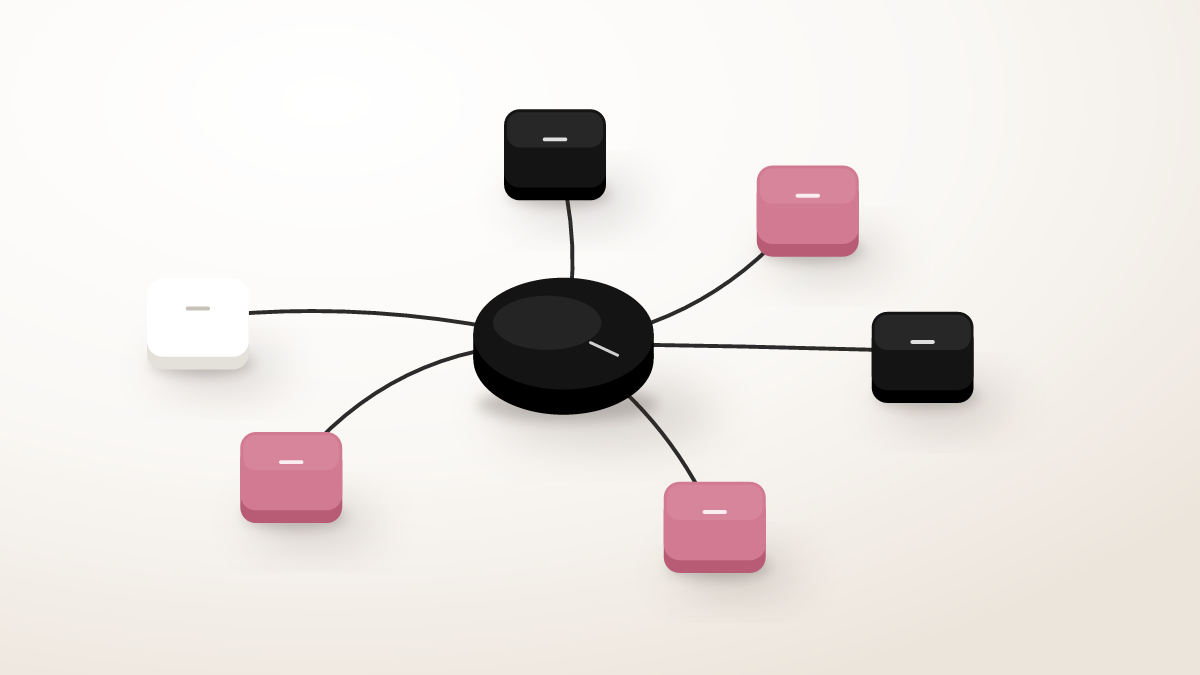
The architecture has three parts. A host (the AI agent), a client the host spins up to talk to one server, and the server itself, which exposes tools and data. Under the hood it runs on JSON-RPC 2.0, the same kind of request-and-response plumbing that has run quietly under software for years. You do not need to know any of that to use it. You need to know that the vendor wrote the server once, so you never write the glue.
The closest analogy is what USB did for hardware. One port, one protocol, one connector that works whether you plug in a keyboard, a webcam, or a printer. Before USB, every peripheral shipped its own cable and its own card. Before MCP, every agent-to-tool link was its own wrapper. For a working catalog of servers a sales team can install today, the MCP directory is the place to start, including deep dives on the Amplemarket and APITable servers. Most of the names on it are tools you already pay for.
The operator judgment here is to treat MCP as table stakes, not as a moat. The protocol stopped being a single-vendor bet the moment competitors adopted it.
Why MCP matters more than another AI SDR
MCP won the integration argument because the people who could have built a rival standard chose not to. OpenAI adopted MCP in March 2025 across the Agents SDK, the Responses API, and ChatGPT desktop. Google DeepMind followed in April 2025, with Demis Hassabis calling it "a good protocol" that is "rapidly becoming an open standard for the AI agentic era." In December 2025 Anthropic donated MCP to the Agentic AI Foundation, a directed fund under the Linux Foundation co-founded by Anthropic, Block, and OpenAI. The standard now outlives any one company's roadmap.
That matters for a buying decision most sales leaders are getting backwards. The 2026 sales stack is the most fragmented part of any GTM org. A typical team owns a CRM, a sequencer, an enrichment vendor, a LinkedIn sender, a signal feed, a scheduler, a chat tool, and a doc store. None of them talk without a paid integration platform in the middle, and every cross-tool action becomes a Zap or a Make scenario that two systems quietly disagree about three weeks later. The operator becomes the integration. That is the job nobody hired for.
The reason MCP beats buying another AI SDR is that an AI SDR vendor sells you a closed box that wraps the same tools you already own, then rents the wrapping back to you with prompts you cannot read. MCP gives you the wrapping as an open protocol. The wins move from the tool bill to the human time that used to sit in the integration seam. This is the same pattern the operator playbook for B2B lead generation describes. Keep humans on the first mile and the last mile, let the middle mile compound. MCP is what lets the middle mile compound without a stack rewrite.
Which MCP servers should a sales team install first
Five servers cover most of what a serious sales team needs. None require leaving the tools you already use. The point is to wire what you have, not buy what you do not. Here is how they map to roles.
| Role | Server | What the agent gets |
|---|---|---|
| System of record | HubSpot MCP | Read deals, update properties, log activities, pull contacts |
| Living knowledge | Notion MCP | ICP memo, objection bank, pricing notes, positioning |
| Team comms | Slack MCP | Read and post in deal channels with teammate-level access |
| Data and signals | Crustdata MCP | Firmographics, contacts, hiring and funding signals |
| Delivery | Gmail or a sender server | The actual email and social send step |
The non-obvious rule is to install three, not five. Three is enough to feel the difference and few enough to debug when something misbehaves. Start with the CRM, because every other tool eventually writes to it. The HubSpot server lets the agent call the API through the protocol and get a real response, which is the line between an AI sales tool that demos well and one that survives a Monday morning. Add a knowledge server second, so every draft pulls the current pricing memo instead of last quarter's. Add a data server third, matched to the signals you already buy. Hold the delivery server until the first three are boring, because a sender wired before the workflow is stable is how an unreviewed draft reaches a prospect.
How MCP servers chain into a real sales workflow
Five servers are not a stack until they chain. Here is a signal-triggered outbound play, step by step.
A new hiring signal lands. The Crustdata server returns the company, the role, the seniority, and the contact for the person making the hire, in one call. The agent then hits the HubSpot server to check whether the company is already in pipeline. If yes, it adds an activity note tagged with the signal. If no, it creates a company and a contact and stamps the hiring signal as a property on both.
Next the agent reads your ICP memo and your hiring-signal playbook from the Notion server. Both are markdown, both live in your workspace, both are versioned, so the agent uses today's language. It drafts a note that references the signal and the angle from the playbook, and it does not send. It posts a draft into the rep's deal channel through the Slack server and waits. The rep reads, edits two words, approves. The agent sends through the delivery server, logs the send into HubSpot, and updates the playbook usage counter in Notion.
One workflow, five tools, zero Zaps. This is the chain that used to require a forty-node graph in n8n or Make, the kind that breaks the moment HubSpot renames a field or a vendor ships a new endpoint. The MCP version holds the contract in the protocol rather than the graph, so a renamed field does not topple the whole flow. It is the same loop the AI SDR field map lays out, where every signal handled and every reply classified feeds the next run from the same workspace.
MCP as a data orchestration platform for sales teams
Once three or more servers are wired, MCP stops being a set of connectors and becomes a data orchestration platform for sales teams. The agent moves data between the CRM, the enrichment feed, and the chat tool in one pass, which is the work sales ops used to script across Zapier, a reverse ETL job, and a spreadsheet. The concrete jobs it absorbs are these.
- Keeping the CRM current. New contacts, deals, and signal properties get written into HubSpot as they surface, so pipeline data stays clean without manual entry.
- Routing signals to the right rep. A funding or hiring trigger from the Crustdata server flows to the deal owner and the right channel in one step rather than a weekly review.
- Enriching on write. Every new account gets firmographics and contacts attached the moment it enters the CRM, not in a batch days later.
- Deduping before create. The agent checks for an existing record before it writes a new one, which kills the duplicate problem at the source instead of in a monthly cleanup.
- Reporting from live data. The agent reads pipeline state and posts a weekly summary into Slack straight from the system of record, so the numbers always match the CRM.
The framing that matters is that this is orchestration you own. The playbook that sets the order of these steps is a markdown file in your workspace, not a flow locked inside a vendor screen, which is what separates an MCP data orchestration setup from buying yet another point tool.
The MCP security risk most guides skip
The integration story is the easy part. The part most MCP-for-sales guides omit is that wiring an agent into your CRM, your prospect data, and your team chat creates a single point of failure with real blast radius. Prompt injection is ranked the number one vulnerability in the OWASP Top 10 for LLM Applications 2025, and inside an MCP setup it takes a sharper form.
The named version is tool poisoning, where a malicious or manipulated tool definition passes into the agent's context and the model treats it as instructions from the developer. It is closer to a supply-chain attack than to a chatbot jailbreak. The supply-chain dimension is documented: CVE-2025-6514, a critical command-injection flaw in mcp-remote, an OAuth proxy with over 437,000 downloads used by Cloudflare, Hugging Face, and Auth0, showed how one bad dependency reaches many stacks. In mid-2025 a Supabase agent running with privileged access processed support tickets that contained attacker-supplied SQL and leaked integration tokens.
The operator rule that follows is to scope every server to the least access it needs and to keep a human on any step that sends, deletes, or writes externally. A read-only data server is low risk. A delivery server with send access and no review gate is the one that ends careers. Run servers you control locally or in your own cloud rather than uploading prospect data into a vendor environment, which is also why regulated teams in finance, health, and legal lean toward self-hosted MCP. The privacy gain and the security discipline are the same move.
Yalc as the orchestration layer over MCP
Servers solve the protocol layer. They do not solve orchestration. Five servers do not run a workflow on their own. Something has to wake up, hit them in the right order, hold context across steps, and decide when a human belongs in the loop.
Yalc is that orchestration layer. It calls the MCP servers you have installed and reads the markdown playbooks that define your workflows. There is no UI to configure. You write a markdown file, drop it in the right folder, and the next prompt picks it up. Three things follow that matter for sales specifically.
Your playbook is text, so it sits in your repo as a file you can edit, review, and version like code rather than locked inside a vendor screen. The system compounds, because every signal handled, every reply classified, and every deal won is written back into the workspace the next run reads from, so by month three the agent writes from a sharper picture of your market than any onboarding flow could give. And you own the prompts, which means you can read them, rewrite them, and test one angle against another without filing a ticket. The same logic runs through Claude Code for sales and the broader agentic GTM operating system pattern.
So the play for this week is not another point tool. Pick three servers, scope them tight, write one markdown playbook, run it once by hand, and let the steps that hurt the most become the ones the orchestration layer owns next. The protocol underneath the stack, run from one Claude Code prompt.
Frequently Asked Questions
What is MCP for sales?
MCP for sales is the use of the Model Context Protocol, an open standard Anthropic released in November 2024, to connect an AI agent to a sales team's existing tools. Each vendor publishes one server and the agent speaks one protocol, so the CRM, the data feed, and the chat app behave as a single workflow instead of separate apps glued together by hand.
Is MCP free to use?
The Model Context Protocol itself is an open standard with an open-source reference implementation, so the protocol carries no license fee. You still pay for the underlying tools the servers connect to, such as your CRM seat or your enrichment credits, and for the agent runtime you use to call them. The protocol removes integration cost, not subscription cost.
Do I need to code to use MCP for sales?
You do not need to write the integrations, because the vendor ships the server and the agent handles the protocol handshake. You do need to install the servers and, for a real workflow, write a short playbook describing the steps. With an operator setup like Yalc that playbook is a markdown file, which is closer to writing a clear brief than to programming.
Is it safe to connect MCP to my CRM?
It can be, with discipline. The main risks are prompt injection and tool poisoning, where a manipulated tool definition feeds the agent bad instructions, so scope every server to the least access it needs and keep a human review step on anything that sends or deletes. Running servers you control rather than uploading prospect data to a vendor environment lowers the blast radius further.
How is MCP different from Zapier or n8n?
Zapier and n8n connect tools through prebuilt or hand-built workflow graphs, which break when a tool renames a field or changes an endpoint. MCP moves the contract into the protocol, so an agent discovers what a server can do at connection time rather than depending on a fixed graph. The result is fewer brittle nodes and a workflow that bends instead of snapping when a vendor ships a change.
Can MCP act as a data orchestration platform for sales teams?
Yes. Once three or more servers are wired, MCP works as a data orchestration layer for sales teams, moving data between the CRM, the enrichment feed, and the chat tool in one pass. That covers the jobs sales ops used to script across a reverse ETL run and a spreadsheet, such as keeping the CRM current, routing hiring and funding signals to the right rep, enriching accounts on write, deduping before create, and reporting from live pipeline data. The order of those steps lives in a markdown playbook you own rather than a flow locked inside a vendor screen, so the orchestration stays yours.